
Honolulu Lookup Records Compared
No official source is a complete list of Honolulu residents. Each custodian answers a narrow question. Start with the record most likely to confirm the fact you need, then use a second source with a matching date or address. Title, tax mail, voter status, a court appearance, and a license are not interchangeable.
| Record | What it can confirm | Official source | Access |
|---|---|---|---|
| Parcel and tax | Fee owner, situs, mailing clue, value, sales history | Honolulu RPAD / QPublic | Free address or TMK search; office and phone help |
| Recorded deed | Grantor, grantee, date, legal description | State Bureau of Conveyances | Online generally from 1976; Room 123 or mail for older books |
| Court case | Party role, case type, status, dates, docket | eCourt Kōkua | Free index; paid PDFs or branch request |
| Voter record | Own registration; limited public name, status, precinct data | OLVR / County Elections | ID-gated self-service or official-purpose request |
| Vital record | Eligible birth, marriage, civil union, or death fact | Hawaiʻi DOH; First Circuit for divorce | Restricted order, mail, counter, or archive route |
| License or entity | Credential status or business-filing role | MyPVL / BREG | Free index; paid documents or written verification |
A known address makes RPAD a useful first check. A name with no address is better tested in eCourt, MyPVL, BREG, the deed index, or a historical directory. None proves present residence alone.
Search Honolulu Court Names Carefully
eCourt Kōkua offers Party, Case, Vehicle, Filing Date, Hearing, and document paths. A person-name search requires last and first name, with optional middle name, phonetic and partial matching, filing dates, and case type. Results can show the case ID, type, status, filing date, court, location, parties, events, dispositions, and docket entries. A PDF icon means an online document may be bought. No icon means the legal-documents branch or a public terminal may be needed.
Name-only matching is the main trap in a resident lookup. Check the party role, aliases, case type, filing date, court, and actual docket. The portal returns no more than 200 results at once, so date and case-type filters can make a common-name search useful. Free terminals at most courthouses and law libraries may also provide a better way to inspect a long file.
| Field | How to use it |
|---|---|
| Last / first / middle | Run exact spelling, initials, married names, and known variants separately. |
| Phonetic / partial | Broaden spelling, then narrow by date and case type. |
| Case type | Keep an unrelated category from creating a false match. |
| Party role and aliases | Distinguish the person from an attorney, entity, or other party. |
| Docket and document icon | Confirm what was filed and whether a PDF is offered online. |
Verify Honolulu Resident Lookup Matches
The soundest process ties a name to a place and date before drawing a conclusion. Honolulu records often distinguish a parcel's situs address from the address used for tax mail. Situs means the physical parcel. The mailing field might lead to an agent, trustee, estate, or off-island owner.
- Write the full name and all known variants, including a middle initial, married name, and spelling with or without Hawaiian diacritics.
- Anchor the person to a dated address, TMK, license number, business filing, or court case rather than relying on a name alone.
- Compare a second independent record. Match dates, party roles, parcel details, or document numbers, not just spelling.
- Open the source record or request the custodian's copy. Record the access date and stop where the proof ends.
The modern address chain belongs in more depth on the Honolulu street directory. For one-person work, its main value is supplying a stable TMK and deed number that can distinguish same-name owners.
- Docket
- The dated list of filings, hearings, orders, and other events in a court case.
- Index versus image
- An index describes a record. An image is the filed document and may require a fee or request.
- Certified copy
- A copy authenticated by the custodian. Certification does not make confidential content public.
- TMK
- Tax Map Key, the parcel identifier that connects Honolulu property, maps, permits, and deeds.
Honolulu Voter Lookup Boundaries
The Hawaiʻi Online Voter Registration portal is for a voter to confirm or update their own record. It asks for first and last name, date of birth, last four Social Security number digits, Hawaiʻi driver license or state ID number, and a captcha. It is not an anonymous public resident lookup by name or street.
HRS §11-97 makes full name, district or precinct, and voter status public. Other affidavit fields are restricted except for election or government purposes. A proper public-file request goes to the Honolulu County Elections Division at 530 South King Street, Room 100, by email, mail, phone, or in person. The office can explain approved fields, purpose, delivery, and protected-voter exclusions. Public precinct maps show civic geography, not household rosters.
Key distinction. Registration status and precinct do not prove that a person now occupies a specific Honolulu home.
Honolulu Vital Record Links
Hawaiʻi Department of Health keeps certified birth, marriage, civil-union, and death records for Oʻahu, subject to direct-and-tangible-interest rules in HRS §338-18. VitRec supports exact-match online orders for eligible birth, marriage, and civil-union certificates from July 1909 forward. Mail and the Room 103 counter at 1250 Punchbowl Street are alternate channels. Historical Oʻahu indexes from 1832 through 1929 are held through the State Archives, though early reporting is incomplete.
A timely change matters: since February 1, 2026, DOH no longer maintains divorce records. An Oʻahu divorce search now goes to First Circuit and may begin with eCourt before a copy request to the Circuit or Family Legal Documents Branch. Certified vital records are evidence of an event or relationship, not an open list of residents. Genealogy researchers can also use Archives, library microfilm, FamilySearch, church records, and newspapers when an early index is missing.
Confirm Honolulu Licenses and Filings
A professional credential or business role can separate one same-name person from another. Open the official MyPVL public license search to search by an individual's or business's name or by license number.
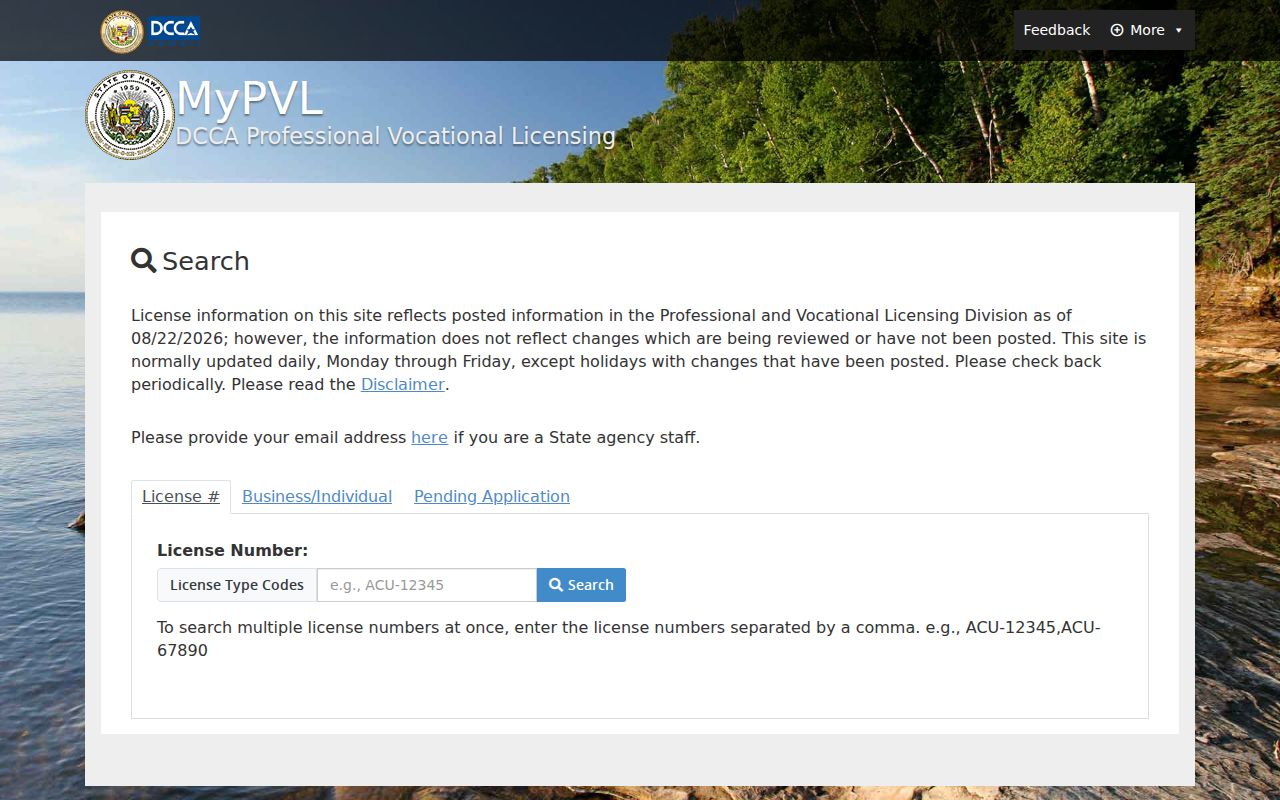
The screen shows why this source works as a verification step: a result may supply license type and ID, legal or trade name, current or expired status, original and expiration dates, and published discipline. Free online data can be backed by a $15 written verification, which DCCA says takes about 20 business days.
BREG covers a different fact. Its entity filings may name officers, managers, or a registered agent and show an entity's status, formation date, address, and documents. A registered office is a business contact, not proof of anyone's home. The online search is free, while formation papers, annual reports, amendments, and certificates may carry stated fees.
Find Honolulu Family Connections
Probate, obituaries, and historic directories are often more useful than current databases for finding an heir or reconnecting with family. Search the First Circuit probate index, note the case number and status, then ask the legal-documents branch which petitions, orders, or inventories are public. An obituary can supply relationships and a date, while a later deed may show how an estate transferred property.
Adoption and confidential Family Court records have separate limits. Hawaiʻi adoption material is not an open name index, so eligible people should use the official state registry or confidential-intermediary route rather than trying to infer a protected identity. A former classmate search can move through Hawaiʻi State Library and UH yearbooks, school archives, newspaper notices, and alumni collections. Preserve the year and school with each name because no consolidated Honolulu yearbook index was found.
When Honolulu Indexes End
Online coverage has real edges. eCourt omits some older case categories and confidential files. Bureau of Conveyances web records generally begin in 1976. Vital certificates require eligibility. RPAD does not offer a public owner-name input in its basic screen. When the normal portal ends, use the custodian's other channel instead of treating silence as proof that no record exists.
For court files, public courthouse terminals and written email, fax, or mail requests reach the right First Circuit branch. A request without a case number may incur a per-name research fee, and older or off-site material can take longer. For a government record outside an ordinary copy process, send a narrow UIPA request to the agency that holds it. Describe the record, date range, and format, and ask for segregable public fields if part is exempt. Historic names can move to State Archives, HSPLS, UH, or microfilm.
Honolulu Resident Lookup Limits
A record can be accurate yet support the wrong conclusion. A deed identifies a recorded interest, not every occupant. A license proves a credential status, not residence. A court name can belong to someone else. Address Confidentiality Program participants may use a substitute address, and sealed, juvenile, adoption, vital, and protected voter information stays restricted.
Correct an error with the office that maintains the record. Save the case, parcel, license, or document number, identify the exact field, and supply proof. UIPA guidance permits a person to seek correction of their own government record. Commercial people-search profiles can blend stale addresses and different people, so their category is not a substitute for the official source.
Lawful use. Use a Honolulu resident lookup for legitimate personal research, and never pursue, threaten, harass, or repeatedly contact anyone.